An A* GCSE Art Exam: Force
Last Updated on January five, 2022
This Edexcel GCSE Fine art exam was completed by Samantha Li, while studying at West Isle School, Pokfulam, Hong Kong. Samantha was awarded full marks for her examination, gaining 100% (A*) overall. She explored a fantasy / spiritualistic theme, interpreting the set starting point 'Forcefulness'.
Two of Samantha'south sketchbook pages are included in our new book: Outstanding High School Sketchbooks . This book has high-resolution images so that fine details and annotation are clear, making it an excellent resource for students and schools. Learn more!
Many students panic when their Fine art exam paper arrives. They worry that they won't be able to come up with a creative interpretation and sometimes spend weeks fretting over their ideas. Samantha's project is a superb reminder that the best way to approach a topic is to ensure that it is grounded in first-hand observation, that you enjoy the procedure and that y'all craft a personal, individual response.
We were lucky enough to interview Samantha about her project. Her answers are below:

What was your GCSE Art examination topic and how did you interpret this?
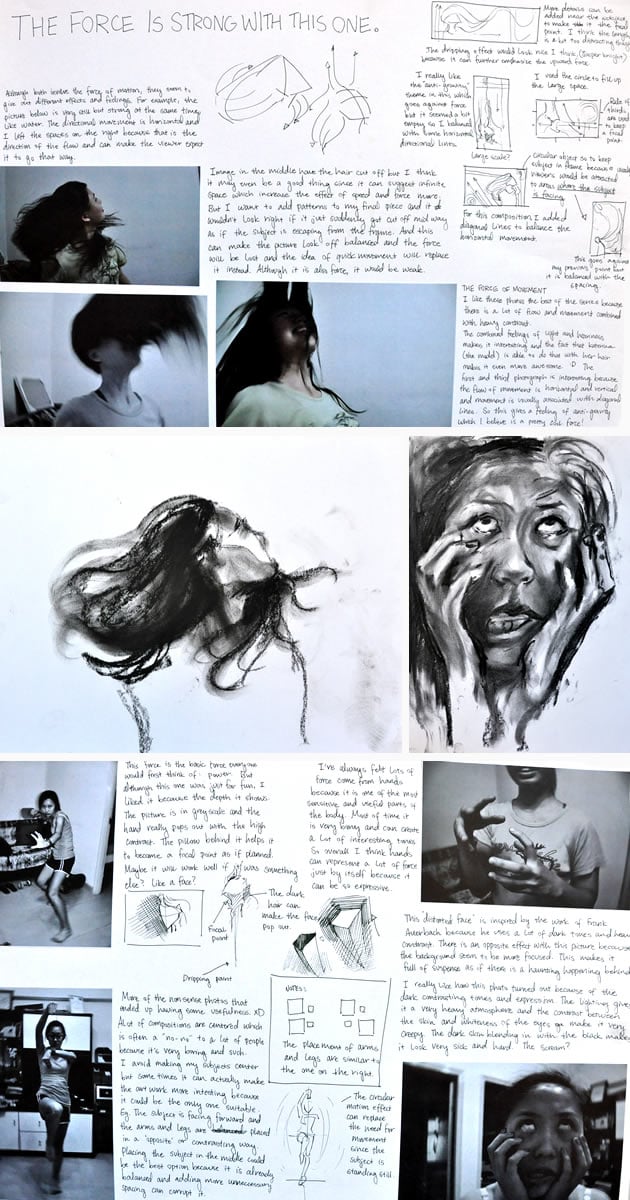
Samantha: The test topic was 'Force' and the first matter I idea of was to do with Star Wars, but that was irrelevant! Force can be linked with annihilation really, so my concepts were generated randomly without whatsoever restrictions. From brainstorming, I listed words relating to forces such as physics, movement, nature, stiff/gentle, internal/external, and anti-strength. I tried to avoid topics that are cliché.
In the end, I went with the concept of 'anti-forcefulness/upside down force'. This reminded me of gravity, which led me to the idea of anti-gravity and infinite! I had a hard time choosing which of the two concepts to paint for the test so I painted both.
The first painting (the vertical image at the end of this article) has a fantasy/spiritual theme. I chose gentle colours and created contrast mainly through complementary colours. I used long castor strokes to create movement, and tried to express transparency through subtle changes in colour and tone.
The second painting has a heavier feeling, while keeping to the concept of anti-gravity. It is more straightforward, equally I used denser shadows and sharper lines. I actually like the second piece amend because I was more confident when applying darker tones and used more materials.
Which artists did y'all written report every bit office of your GCSE Fine art exam?
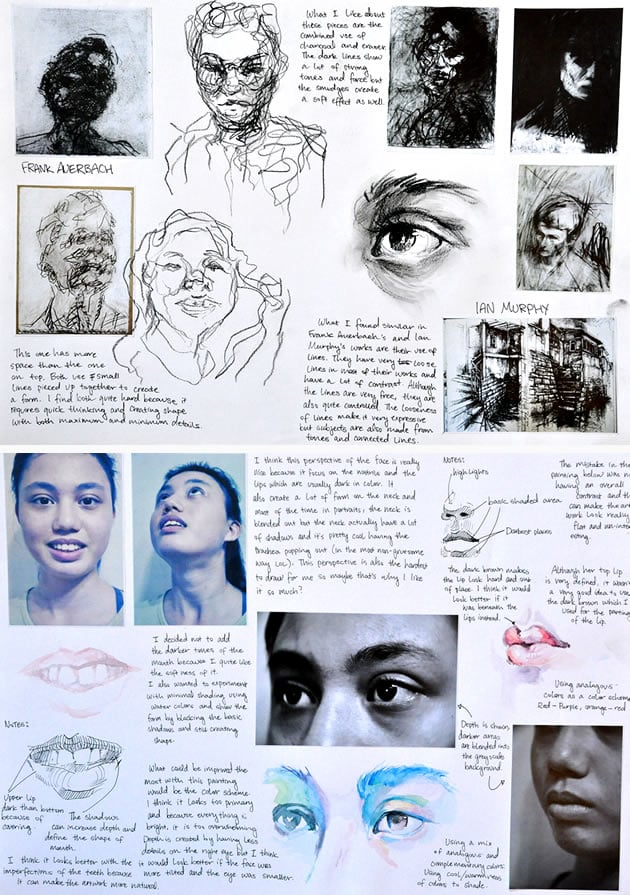
Samantha: Frank Auerbach has a very free-flowing manner that helped me 'let go'. The lines in his sketches are broken and delicate, contrasting with the dark tones, weighing downwardly the discipline within. A mixture of both lite and heavy is often hard to achieve, so information technology immune me to experiment with pressure level, bending, and speed. I decided to research Auerbach considering the technique he used is a completely different approach to what I am used to, which I find intriguing.
Edvard Munch and Laura Ford were two suggestions from the exam booklet. Both artists portray some kind of grim imagery in near of their works that provoke feelings of misery and shock. As a horror fan, I was captured past Laura Ford's realism and dynamic motion in her 'Weeping Daughter' sculptures. It was similar watching Alice losing her style from Wonderland and ending up in Silent Hill. And Edvard Munch's utilize of colors and composition gave his painting 'Workers on their way abode' a sinister effect.
Carne Griffiths and Silvia Pelissaro (too known every bit Agnes-Cecile) are popular artists that I discovered online. They have a lot of similarities and what I love the most is their utilize of colors and blueprint. Every bit someone completely new to watercolors, their works are highly inspiring and delicate.

What communication exercise you have for other high schoolhouse Art students who wish to gain excellent grades?
Samantha: The major focus in GCSE art is experimentation and introduction to how creative development works. The criteria is actually quite uncomplicated if broken down into four steps: inquiry, tape, experiment, and reverberate. I plant the recording part the hardest because learning comes naturally and, as most artwork has similar qualities that makes them neat (such every bit dissimilarity, complementary colors, etc), I ever terminate up writing about the same things over and over once more. Just that's okay! Looking back at the stuff I wrote, I tin can't assistance just express joy how lucky I am that the examiner and my teacher liked my strange sense of sense of humor!
During the process of making, take time on planning the artwork such every bit limerick, temper (warm? cold?) and style. Quality over quantity! Don't be afraid to put more fourth dimension into a unmarried artwork. Get heavy when applying lines/pigment and this will save you a lot of fourth dimension.
Last but non least – you probably know this deep down already – don't be afraid to speak up and declare what you similar or dislike. For example, if you want to draw a purple llama, and so practice it. If your friend draws a dinosaur, so he/she doesn't beloved llamas every bit much as you!
Note: We accept a special commodity for students who wish to draw purple llamas and dinosaurs coming soon!

If you lot enjoyed this article, you may too like to view Samantha's GCSE Coursework project (she was awarded full marks for this also).
You may similar to encounter more of our featured painting and drawing projects from high-achieving Art students around the world.

Amiria has been an Fine art & Pattern teacher and a Curriculum Co-ordinator for seven years, responsible for the course blueprint and assessment of pupil piece of work in ii high-achieving Auckland schools. She has a Available of Architectural Studies, Bachelor of Architecture (First Class Honours) and a Graduate Diploma of Teaching. Amiria is a CIE Accredited Art & Design Coursework Assessor.
browntileords1999.blogspot.com
Source: https://www.studentartguide.com/featured/gcse-art-exam-force
0 Response to "An A* GCSE Art Exam: Force"
Post a Comment